A planter is one of the most popular things to 3D print. But the first time you pour water into one, you may find a drop appearing on the side or under the base. A 3D print is built from layers and lines, and tiny gaps can form between them. This guide explains where leaks come from and which settings make a pot watertight in practice.
First: does your pot need to be watertight?
Most plants do not want wet feet. An ordinary planter therefore has a drainage hole and a saucer underneath. The pot itself then does not need to be watertight; the saucer does. There are three situations:
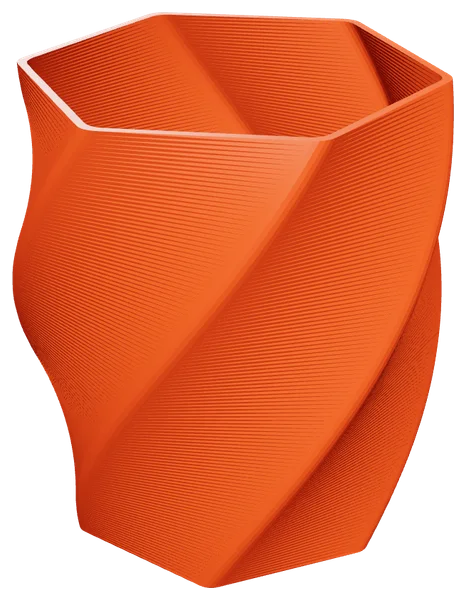
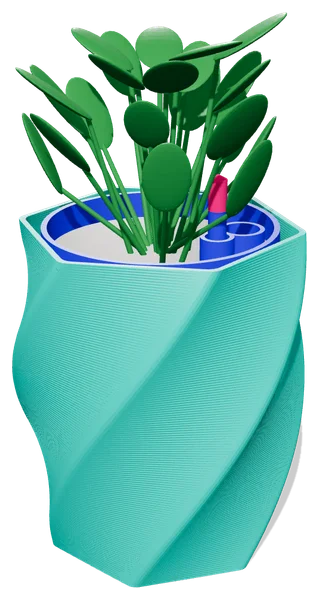
- Pot with drainage hole and saucer. Only the saucer must hold water. This is the easiest and most plant-friendly option. The Twisted Hex Planter works this way: an 8 mm drainage hole and a separate saucer.
- Cover pot without a hole. You place a nursery pot inside. A little water at the bottom is normal, so the cover pot must be watertight.
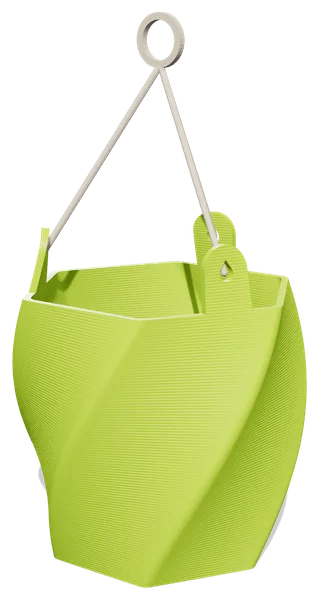
- Pot with a built-in reservoir. Like the Hanging Hex Planter: excess water drains through small holes in a false floor into a closed reservoir. That reservoir must be watertight, or it will drip on the floor anyway.
Why does a 3D print leak?
- Too few walls. With two thin lines, the chance of a tiny gap is high.
- Under-extrusion. If the printer lays down slightly too little filament, the lines do not fully close up.
- Poor layer adhesion. Printed too cold, or with too much cooling, and the layers do not fuse properly.
- The seam. Where each layer starts and ends (the z seam), a small gap often forms.
- Too few bottom layers. A thin base with a gap in the first layer leaks straight away.
- Wet filament. Bubbles in the filament leave small voids in the wall.
Settings for a watertight planter
| Setting | Advice |
|---|---|
| Material | PETG preferred: better layer adhesion and better resistance to moisture and sun |
| Walls | 3 or more |
| Bottom and top layers | At least 5 |
| Temperature | At the warm end of your filament's range |
| Cooling | No more than needed; lower for PETG than for PLA |
| Flow | Well calibrated; if in doubt, a few percent higher |
| Line width | Slightly wider than the nozzle, for example 0.45 to 0.5 mm with 0.4 mm |
| Filament | Dry |
These values match what we recommend for our own planters. For the Hanging Hex Planter the advice is: print floor-down, 3 walls and at least 5 bottom and top layers, so the reservoir stays watertight.
Vase mode: fast and beautiful, but not always sealed
In vase mode (spiral vase) the slicer prints one continuous spiral wall, with no seam and no infill. It is fast and gives a smooth outside. The downside: there is only one line between inside and outside. A single weak spot is enough for a leak.
If you still want to print in vase mode:
- Use a wider line. A 0.6 mm line width with a 0.4 mm nozzle gives a thicker, stronger wall. We recommend this for the vase mode version of the Twisted Hex Planter too.
- Print a little hotter and slower for better bonding.
- Use it as a cover pot with a nursery pot inside, and do not pour water directly into the vase mode pot. That is what our vase mode version is intended for.
A larger nozzle (0.6 or 0.8 mm) gives even thicker walls and is often used for vases and planters.
Test before the plant goes in
- Put the pot or saucer on a dry tea towel or a sheet of kitchen paper.
- Fill it with water to just below the rim.
- Wait a few hours, or overnight.
- Check whether the paper is wet, and where.
If it leaks somewhere, reprint with more walls or a higher temperature, or seal the print.
Sealing afterwards
If a print leaks in one spot, there are ways to seal it:
- Coat the inside with a thin layer of two-part epoxy (the kind made for coating prints). It closes every gap.
- A waterproof lacquer or sealer on the inside, suitable for plastics.
- A plastic liner or nursery pot if you do not want to apply anything.
Always read the manufacturer's instructions for coatings. Not every lacquer bonds well to PETG or PLA.
PLA or PETG for planters?
For a decorative pot in a dry, not too sunny spot indoors, PLA is fine. If the pot gets water or sits in sun behind glass, choose PETG. PLA softens around 55 to 60 °C, which a sunny windowsill can reach sooner than you would think. Read more in our guide PLA vs PETG.
Tips for the plant itself
- In a pot with a false floor, put a piece of fleece or a coffee filter on the floor so soil does not wash through the holes.
- A reservoir in a hanging planter only catches a limited amount of water (about 37 ml in the Hanging Hex Planter). Water little and often rather than a lot at once.
- Keep an eye on the weight of hanging planters. Wet soil is heavy; for the Hanging Hex Planter the advice is to stay under about 1.5 kg.
Planters designed for this
- Twisted Hex Planter: planter with an 8 mm drainage hole, separate saucer and a vase mode version as a cover pot.
- Hanging Hex Planter: hanging planter with three hanging eyes and a reservoir under a false floor, printed without supports.
Both are digitally checked for printability and fit a 180 mm print bed. Browse all planters or read on about infill and walls.